
Texas is hard on houses. Stay a week ahead of it.
Hail, drought, and 100° weeks are working on your home right now — mostly where you can't see it. Get a free weekly read on what conditions in your ZIP are doing to roofs, foundations, and AC systems, built from the same public records insurers and inspectors use.
Takes about two minutes. Updated every week from NOAA, the U.S. Drought Monitor, and city permit records.
Austin conditions
- Recorded events in this window88Live
- Current categoryD3Live
- Roof-related permits in this window2,112Live
Source: NOAA Storm Events Database · U.S. Drought Monitor · City of Austin Issued Construction Permits (Socrata) · confirmed Oct 6, 2026
What Texas threw at homes this week
Every number below is computed from public records, with its source and last-confirmed date attached. Follow any card for the full dataset and its limitations.
The expensive stuff starts quietly
Most five-figure home repairs in Central Texas don't start with a disaster. They start with an inch of hail nobody documented, a drought year that moved the soil under the slab, or a summer that ran the AC 11 days straight over 100°.
A roof replacement, a foundation repair, or a new HVAC system each typically runs well into five figures. Knowing what your area's been through — this week, this season — is how you catch small problems while they're still small, and how you know whether the contractor at your door is telling the truth.
Something on your mind?
Start with the problem, not the paperwork. Pick what's going on and see what we know about it locally.
Nothing going wrong today? Good — that's the best time to look. Check this week's conditions in your ZIP →
How Texas Home Intelligence works
No black box. Every number on this site falls into one of four buckets, and each one is labeled so you always know what you're looking at.
Public / observed data
Information directly reported by authoritative sources — weather services, permit systems, and state agencies.
Historical context
How a current value compares with previous conditions or seasonal norms, not just a single snapshot.
THI analysis
Our own plain-language interpretation of what the data may mean for a homeowner's project or timing.
Estimates & homeowner information
Modeled values and anything a homeowner tells us directly are always clearly labeled as such.
The map that moves your foundation
The U.S. Drought Monitor publishes a new Texas map every Thursday. In Central Texas clay soil, that map is a slow-motion picture of the ground expanding and shrinking under your slab — which is why it's one of the five signals in your ZIP's score.
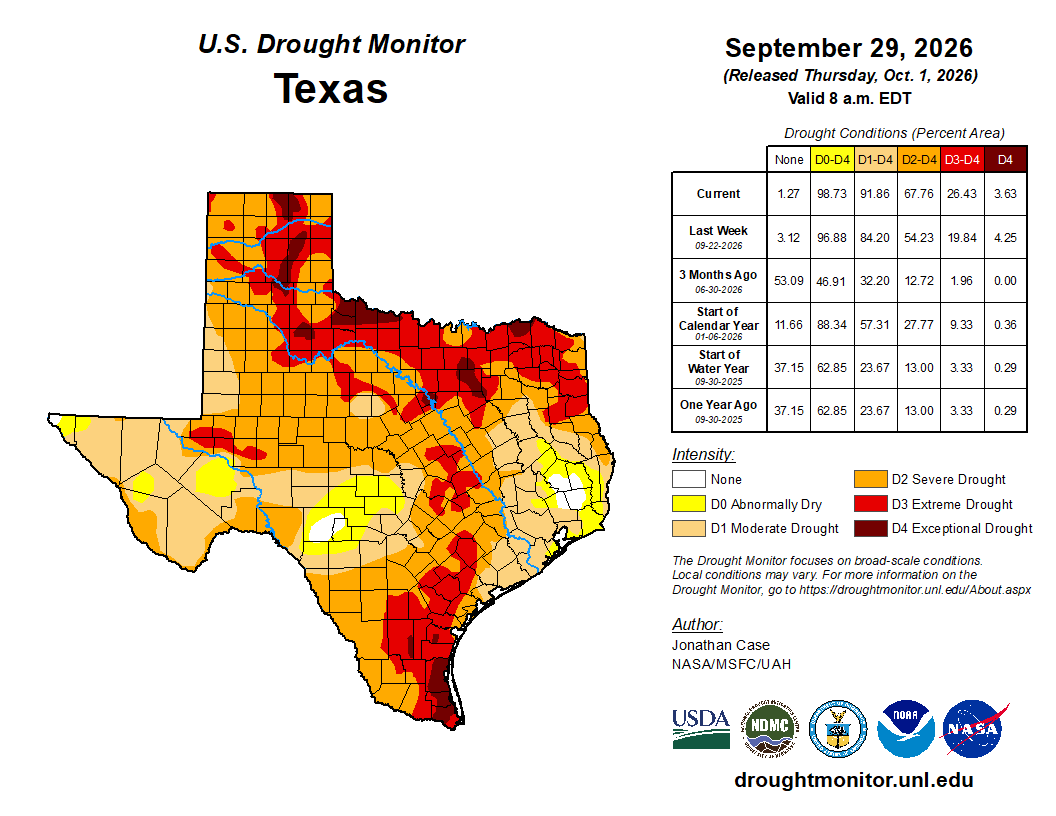
U.S. Drought Monitor — updated weekly
U.S. Drought Monitor map — see current Texas drought conditions.
Built from primary sources
Weather & Climate
- NWS
- NOAA
Texas Water & Drought
- U.S. Drought Monitor
Hazards
- FEMA
- Texas A&M Forest Service
Housing & Permits
- Census
- City / municipal permit systems
Insurance
- Texas Department of Insurance
Costs & Energy
- BLS
- EIA
- ERCOT
Environment
- EPA AirNow
- USDA
Latest analysis
What does San Antonio's police offence data actually cover?
San Antonio publishes 538,978 offence records covering January 2023 to August 2026. Eight columns, no blanks, no address, and 8.5% of rows share a report ID with another — a row is an offence, not a report. What the file contains, measured against the file itself.
538,978 records44 months, 8 columns, no addressCity of San Antonio · Aug 2026
Did Austin's AC rush follow the heat in August 2026?
Austin's cooling demand and HVAC permit filings in August 2026, two measured series side by side, with no cause claimed.
1,037 HVAC permitsdown 15% month over monthCity of Austin · Aug 2026
Is San Antonio's remodel boom cooling off? (Aug 2026)
Every San Antonio trade measured against its own recent pace for August 2026, from the city's own permit record.
451 tree permits103% above its 11-month averageCity of San Antonio · Aug 2026
Already dealing with a problem? Walk in with the facts.
Turn what you know — and what the data shows for your area — into a clear project brief before you talk to a single contractor. Free, and yours to use with anyone.
Build a Project BriefFree • Use it with any contractor • Contractor introductions are optional
Frequently asked questions
Does Texas Home Intelligence diagnose my home?
No. It organizes the information you provide and identifies questions or items a qualified professional may need to evaluate. It does not replace an inspection or professional diagnosis.
How many contractor quotes should I get?
For most non-emergency projects, two or three is common practice. It matters more that each contractor is quoting the same scope of work than exactly how many quotes you collect.
How often is Texas Home Intelligence data updated?
Cadence depends on the source and is stated on every data page. Because several sources publish on a lag, each page shows two dates: how far the records themselves run, and when we last confirmed the feed.
Is QuoteReady really free?
Yes. You can create your Project Brief for free and use it with any contractor.
Do I have to talk to contractors through Texas Home Intelligence?
No. Contractor introductions through Texas Home Intelligence are optional and never required to use your brief.
Can I use the brief with my own contractor?
Yes. Your Project Brief is yours to use with anyone — a contractor you already trust, one you find yourself, or one Texas Home Intelligence introduces you to.
What is a QuoteReady Project Brief?
A standardized summary of your home project — the problem, property context, priorities, and questions a contractor should answer — built from what you tell us.
Where does Texas Home Intelligence get its data?
From public sources including NWS/NOAA weather and storm data, municipal permit systems, the U.S. Drought Monitor, the EIA, and other government and utility sources. Every published figure names its source and the date it was last confirmed.